
Rajasthan has made ABDM compliance mandatory for hospitals — and for many hospital owners and administrators, the first reaction is the same: what exactly does that mean for us, and where do we start?
ABDM compliance for hospitals is not a single switch to flip. It is structured across three milestones — M1, M2, and M3 — each covering a different layer of your hospital’s digital health infrastructure. Each milestone applies differently to each hospital. Understanding which one applies to yours — and what it requires from your IPD documentation — is where any serious compliance plan must begin.
This post breaks down what each milestone actually involves, where IPD documentation sits within this framework, and what hospital owners should look for in a software partner as they navigate this transition.
What Is ABDM and Why Is Rajasthan Making It Mandatory?
The Ayushman Bharat Digital Mission (ABDM) is India’s national initiative to create a unified digital health ecosystem — connecting patients, hospitals, doctors, and insurers on a single interoperable platform. At its core, ABDM gives every patient a unique 14-digit ABHA ID that links all their health records across providers, regardless of which hospital or clinic they visit.
For hospitals, ABDM integration means your systems can create ABHA IDs for patients, link their clinical records to those IDs, and share structured health data securely — with patient consent — across the national health network.
Rajasthan’s mandate reflects a broader national push. ABDM adoption is set to accelerate in 2026, with the government pushing for compliance, particularly among AB-PMJAY empanelled hospitals. Purpleipd For Rajasthan hospitals empanelled under Chiranjeevi Yojana — which provides substantial cashless health cover to families across the state — digital documentation and ABDM alignment are becoming non-negotiable requirements for continued empanelment.
The Three ABDM Milestones: What Each One Covers
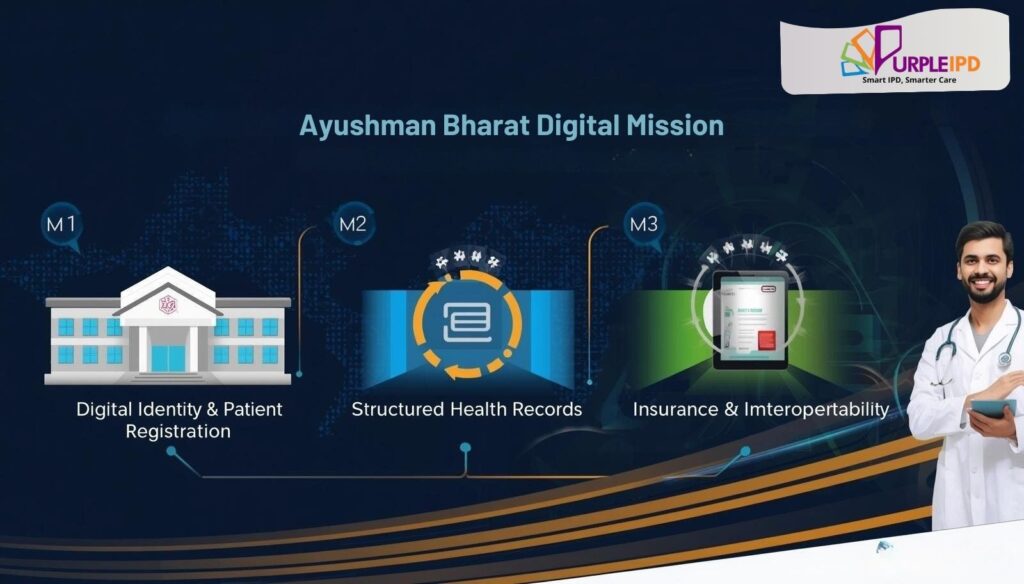
ABDM structures compliance across three milestones for healthcare software — M1, M2, and M3 — each defining a different level of digital health readiness. Mind Medical Care
M1 — Digital Identity and Patient Registration
The M1 module is critical for ensuring that healthcare providers are properly registered, verified, and easily accessible within a secure national framework. Purpleipd At the hospital level, M1 means your systems can create and verify ABHA numbers for patients at the point of registration, and link those ABHA IDs to patient records within your HMS or IPD system.
This is the foundational layer. Without M1, your hospital cannot participate effectively in any ABDM-linked workflow — including government scheme claim processing.
M2 — Health Facility Registration and Structured Record Sharing
The M2 module enables the registration of healthcare facilities in the Health Facility Registry (HFR) Purpleipd and introduces structured health record exchange. At M2, your hospital’s clinical records need to be formatted in a way that can be shared securely — with patient consent — across the ABDM network.
For IPD documentation specifically, M2 is where the quality and structure of your inpatient records become critical. Free-form handwritten records cannot meet ABDM sharing requirements in ABDM-compliant ways. Structured digital IPD records — with typed entries, standardised fields, and proper document types — are a prerequisite.
M3 — Advanced Interoperability and Insurance Exchange
M3 represents the most advanced level of ABDM certification, preparing hospital software for larger national integrations, including structured insurance exchange frameworks such as the National Health Claims Exchange (NHCX).
Hospitals with high Chiranjeevi Yojana or PMJAY patient volumes should pay close attention to M3. This milestone directly shapes how insurance claims will be processed going forward. For hospitals handling government insurance schemes like PMJAY, M3 compliance becomes increasingly important — without advanced interoperability, automated claim routing remains limited.
Where IPD Documentation Fits in ABDM Compliance
IPD documentation sits at the intersection of all three milestones — and it is one of the most operationally complex parts of ABDM compliance for a hospital to get right.
At M1, your staff must capture the patient’s ABHA number at every IPD admission. This means your admission workflow — whether paper-based or digital — needs to integrate ABHA creation and verification from day one.
At M2, every inpatient record — nursing notes, doctor orders, medication charts, investigation reports, discharge summaries — needs to be structured in formats that the ABDM ecosystem can read and share. A handwritten IPD file or a scanned PDF cannot meet this requirement.
At M3, your discharge documentation and insurance claim packages need to be formatted for NHCX-compatible exchange — enabling direct digital claim submission to insurers without manual document assembly.
This is why the move to a paperless IPD system is not just an operational decision for Rajasthan hospitals — it is increasingly a compliance decision.
What to Look for in an ABDM-Ready IPD Solution
Not all paperless IPD software is ABDM certified. And ABDM certification alone does not mean a system handles your hospital’s specific documentation requirements out of the box. Here is what hospital owners should verify before selecting a software partner:
ABDM certification status — has the software achieved NHA certification? Ask to see the certification documentation, not just a claim on the website.
ABHA ID integration at admission — can the system create and verify ABHA numbers directly within the patient admission workflow, without requiring a separate process?
Structured IPD record formats — are records captured in structured, typed formats that can be exported in ABDM-compatible data standards? Or are they free-form text entries?
HCX integration for insurance claims — for hospitals under Chiranjeevi Yojana or PMJAY, does the system support NHCX-compatible claim documentation?
On-premises deployment option — given India’s DPDP regulations, does the system allow patient data to remain within your hospital’s own infrastructure rather than on external cloud servers?
Implementation support — ABDM integration involves coordination with NHA, sandbox testing, and staff training. A software vendor that provides hands-on implementation support significantly reduces the time and complexity of your compliance journey.
PurpleIPD is ABDM certified and handles the IPD documentation layer of your compliance requirements — including ABHA ID integration at admission, structured digital records, and HCX-compatible claim documentation. Every hospital’s specific milestone path depends on their starting point and existing systems, which is why we recommend an honest conversation about your hospital’s current setup before making any decisions.
The DHIS Incentive: A Financial Upside to Compliance
Beyond regulatory compliance, ABDM offers a direct financial incentive for hospitals through the Digital Health Incentive Scheme (DHIS). Digital Solution Companies providing health services become eligible for DHIS incentives after successful integration with ABDM across all three milestones. PurpleIPD Hospitals that link patient records with ABHA IDs through ABDM-compliant systems earn per-transaction incentives — effectively being paid to comply.
For a hospital processing hundreds of IPD admissions monthly, these incentives are not trivial. They represent a direct financial return on the investment in going paperless and ABDM-compliant.
Conclusion
Rajasthan’s ABDM mandate is a signal of where Indian healthcare is heading — not just in one state, but nationally. Hospitals that treat this as a disruption will struggle. Compliance becomes costly to retrofit. The longer the delay, the harder the catch-up. Hospitals that treat it as a structured modernisation opportunity — starting with their IPD documentation layer — will find themselves better positioned for insurance claim processing, government scheme empanelment, and the digital health ecosystem of the next decade.
The path to ABDM compliance is not the same for every hospital. Your existing systems, patient volumes, and scheme empanelments determine which milestones apply, patient volumes, and scheme empanelments. The right first step is understanding where your hospital currently stands — and which milestone is both achievable and most impactful for your specific situation.
If you are a hospital owner or administrator in Rajasthan navigating ABDM compliance, we are happy to have an honest conversation about what that looks like for your IPD documentation specifically.