
By PurpleIPD Team · Hospital Billing & Compliance · 4 min read ·
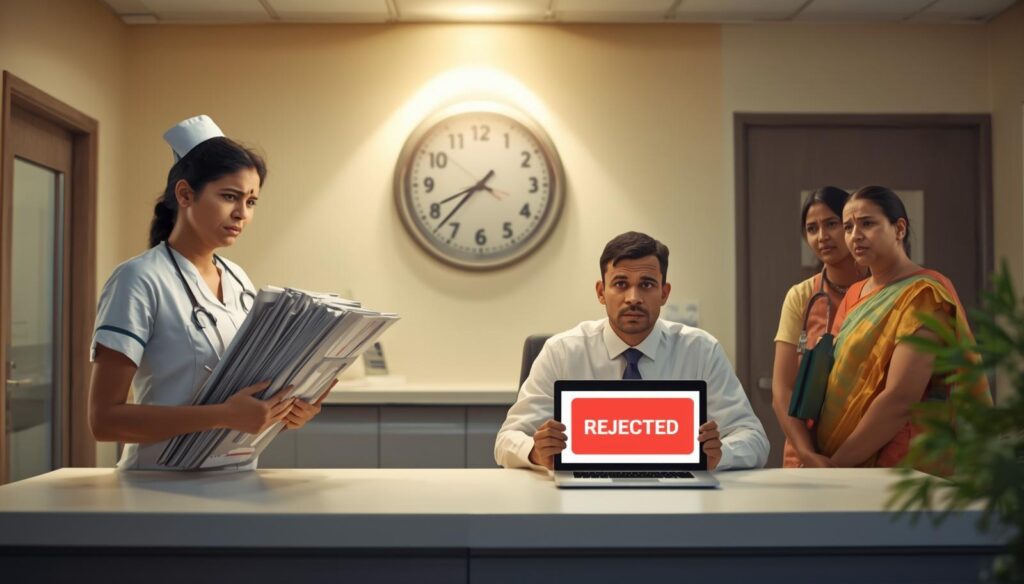
On April 1, 2026, IRDAI’s revised cashless framework went live. Most hospital billing teams have heard rumours. Very few have read what actually changed. Here is the short version — with the parts that directly affect your TPA desk.
The Number That Changes Everything: 32%
IRDAI’s own mandatory disclosure for Q4 2025 shows that 32% of reimbursement rejections were due to illegible discharge summaries. Not fraud. Not policy exclusions. Handwriting.
That number is now publicly tracked. It will be used in insurer network audits. And under the April 1 framework, a documentation problem is no longer just a query — it is an auto-decline trigger.
The Three Changes — Plain Language
1. The 15-day clock is now fully in your hands
The settlement deadline is not new. What is new is the explicit clarification: the clock starts only when your hospital submits the final discharge summary plus all supporting documents. Not at discharge. Not when billing is generated. When the complete package lands with the insurer.
A hospital that takes two days to assemble and submit has given away two days of the insurer’s 15-day window — and has no recourse if the insurer is slow.
2. Three new auto-decline triggers (active from March 25)
These are not technicalities. They are the top three patterns IRDAI documented in rejected claims:
- Date mismatch between the discharge bill and discharge summary — one wrong year (2025 vs 2026) is sufficient grounds for auto-decline, no query letter issued
- Post-window coverage denials — insurers cannot cite exclusions after the 15-day window has elapsed; if they do, they owe principal plus 2% compound interest
- Hospital-originated delays shifting liability to the hospital — if radiology or histopathology delays the discharge summary, that delay is the hospital’s problem, not the insurer’s
What HMAI tried to do: On March 22, 2026, hospital associations met IRDAI in Bengaluru and argued that radiology delays are beyond hospital control. IRDAI rejected the plea and stood firm on Clause 4. Investigation delays are your liability.
3. QR code at reception — mandatory from April 1
Every cashless network hospital must display an IRDAI QR code at reception linking to the real-time claim status portal. Minor task, but it is inspectable during network audits. Get it printed this week.
What This Means for Your Discharge Documents Specifically
The auto-decline triggers are almost entirely documentation problems. And documentation problems in Indian hospitals cluster around three things: illegible summaries, date mismatches across multiple manually written forms, and missing fields discovered only at the point of submission.
A typed discharge summary eliminates the illegibility trigger entirely. A system where the treatment plan filled at admission auto-populates the discharge summary eliminates the inconsistency trigger — because the same data flows through, not manually re-entered. Addressographs on every page with a digital stamp eliminate the “wrong patient” query that TPAs use to kick back files.
These are not theoretical improvements. They address the three most common reasons a cashless claim gets kicked back before the 15-day clock even starts.
PurpleIPD specifically: Discharge summaries are typed with fields mapped from the initial treatment plan — no re-entry, no inconsistency. Every clinical photograph is geo-tagged and timestamped. Mandatory addressographs appear on every page. Digital stamps replace manual ones. The result is a claim package that is consistent, legible, and complete before the patient leaves the ward.
Five Things to Do This Week
- Map your current discharge-to-submission time. If it is more than 4 hours, you are losing days off the 15-day clock on every cashless claim
- Run a date audit on last month’s submissions. Pull 10 random claim files and check that admission date, discharge date, and investigation report dates are identical across all documents
- Add a second-person check before any cashless claim packet leaves the TPA desk — specifically for date consistency and document completeness
- Track pending investigation results as a discharge blocker, not an afterthought — Clause 4 makes this a billing team problem, not just a clinical one
- Print and display the IRDAI QR code at your hospital reception desk
See how PurpleIPD handles discharge documentation for cashless claims
A 20-minute walkthrough covering typed discharge summaries, addressograph generation, geo-tagged clinical photographs, and digital stamps — using your hospital’s actual form layouts.