
The Real Reason Insurance Claims Get Stuck
Ask any hospital billing manager and they’ll tell you the same thing. The claim was submitted on time. The treatment was legitimate. But the TPA came back with queries — asking for more evidence, questioning severity, or requesting re-submission of documents already sent once.
Each query adds days, sometimes weeks, to the payment cycle. Each re-submission means someone is pulling physical files, unfiling documents, scanning pages, and emailing bundles to the insurer — hoping nothing gets missed. This isn’t a billing problem. It is a documentation quality problem.
Under IRDAI’s 3-hour discharge rule, insurers must grant final authorisation within 3 hours of receiving a discharge request from a hospital. But that clock only starts ticking once your documentation is complete and submitted. If it takes your team a day to assemble the file, you’ve already lost the advantage the regulation was designed to give you.
Paperless IPD doesn’t just digitise the same old records. Done right, it fundamentally changes the richness of what you can submit — and that changes how quickly and confidently insurers can approve.
1. Photo Evidence with Geo-Tags and Timestamps: The Biggest Reducer of Claim Queries
One of the most persistent reasons claims get queried is that paper records cannot prove what happened. A written note saying “deep laceration on left forearm, 8cm” leaves room for the TPA to question severity. A timestamped photograph of that injury — taken on the ward tablet the moment the patient arrives — leaves none.
PurpleIPD’s Clipboard feature allows clinical staff to attach photographs directly to the patient record at any stage of the IPD journey: admission injury photos, pre-operative condition, post-surgical outcomes, wound progression across dressing changes. Each image is automatically tagged with the date, time, and GPS location at the point of capture.

For the TPA, geo-tagged, timestamped clinical photographs are unambiguous. The severity of the condition is visible. The timeline is verifiable. The geo-tag confirms the photo was taken at your facility, not assembled retrospectively. There is simply nothing left to query.
This level of evidence is structurally impossible with paper-based records. No amount of detailed handwriting substitutes for a clinical photograph taken in the moment.
2. No More Unfiling, Scanning, and Mailing
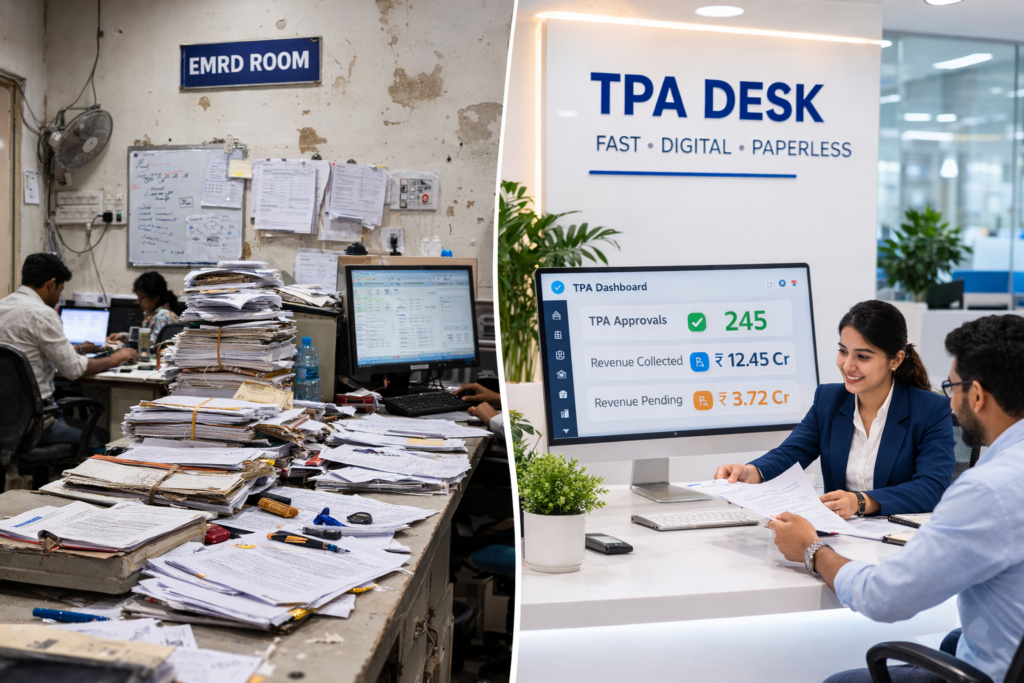
With paper IPD records, submitting a claim or responding to a query follows a predictable and exhausting cycle: locate the physical file in the MRD, unfile the relevant pages, scan each sheet, assemble the PDF, and email it — hoping nothing is missing, skewed, or out of order.
For a hospital processing 50–100 insurance claims simultaneously, this alone consumes significant staff hours every week. And when the TPA returns with a follow-up query, the entire sequence repeats.
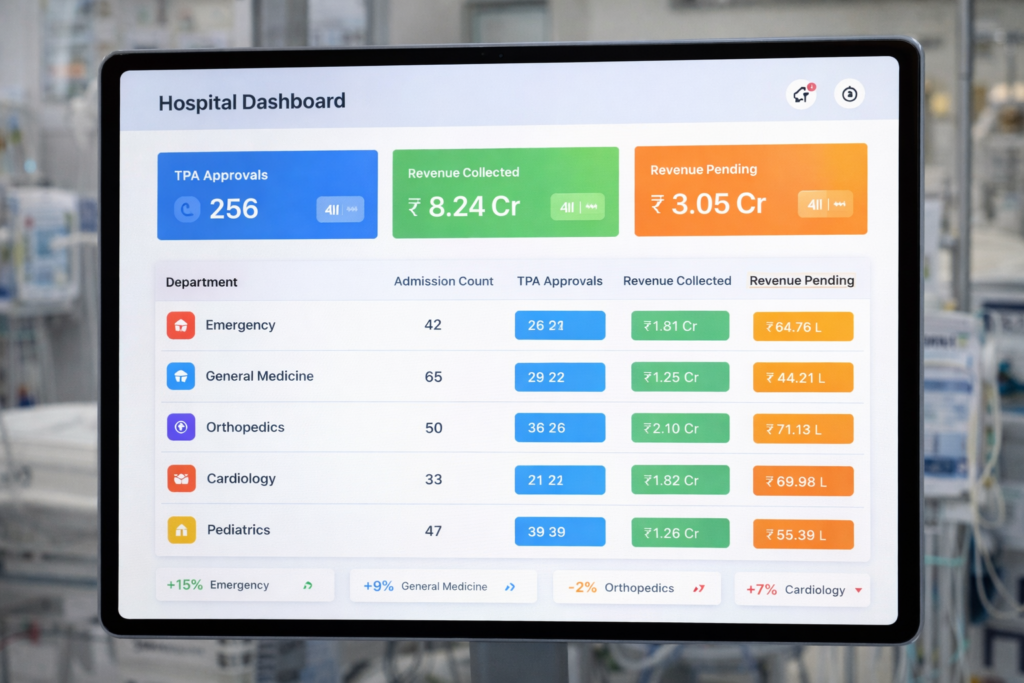
With digital IPD records, the complete patient file — nursing notes, doctor orders, investigation reports, consent records, photographs, discharge summary — is assembled in one place from day one of admission. A claim package can be pulled and exported in minutes. When a query arrives, your billing team responds the same day rather than the same week. Multiply that speed across your entire monthly claims pipeline and the cash flow impact is substantial.
3. Pre-Approval Templates: Submit Faster, Collect Revenue Sooner
For planned procedures and surgeries, TPA pre-authorisation must be obtained before treatment begins. In a paper-based system, assembling the pre-approval package — clinical history, proposed procedure, estimated costs, supporting documentation — is a manual task every time, for every patient, for every insurer format.
PurpleIPD’s print templates are pre-configured to your hospital’s requirements and the formats expected by major TPAs and insurers. When a patient is admitted for a planned procedure, staff select the relevant pre-approval template and the system automatically pulls required data from the patient record. Staff then download only the specific pages that insurer requires — not the entire file.
The package is ready in a fraction of the time. Pre-approvals go out faster, treatment begins sooner, and the billing cycle starts earlier. At discharge, the final claim template works the same way — pulling all required documentation with one click, formatted correctly, ready to send.
IRDAI guidelines require claims to be settled or rejected within 30 days of receiving all necessary documents. Purpleipd The faster and more completely you submit, the sooner that 30-day window begins — and the sooner revenue lands.
4. Auditable Consents: Protection from Litigation and Claim Complications
Insurance claims are one side of the legal exposure hospitals carry. The other is patient disputes — disagreements over whether a procedure was explained, consented to, and documented properly. In an adversarial situation, a missing or challenged paper consent form can delay claim settlement or trigger a much more costly legal process.
PurpleIPD records consent digitally with a complete audit trail. Video consent captures the actual conversation between the doctor and patient — what was explained, what was acknowledged, and what was agreed to. Every entry is timestamped and attributed to the staff member who recorded it.
For TPA and litigation purposes, this is a fundamentally different level of protection. The consent is not a piece of paper that could be questioned for authenticity. It is a verifiable, timestamped record of an informed conversation — one that cannot be lost, tampered with, or disputed as missing.
This matters especially for procedures under PMJAY (Pradhan Mantri Jan Arogya Yojana), where documentation requirements are stringent, and disputes over consent can complicate or block reimbursements entirely.

5. NHCX Integration: The Future of Paperless Claims in India
India’s National Health Claims Exchange (NHCX) is building the infrastructure for direct digital claims submission between hospitals and insurers — eliminating TPA paperwork loops entirely for empanelled facilities.
Hospitals that have already moved to structured digital IPD records are best positioned to benefit when NHCX adoption scales. PurpleIPD’s ABDM and HCX integration means your hospital’s records are structured in the formats this ecosystem requires — so you are not playing catch-up when digital claims submission becomes the standard.
The Compounding Effect on Revenue Collection
Each improvement — richer photo evidence, faster document assembly, pre-approval templates, auditable consents — has individual value. The real impact is in how they compound.
Fewer TPA queries mean fewer delays in the approval cycle. Faster pre-approvals mean treatment and billing begin sooner. Same-day discharge documentation means claims are submitted while the case is still active. Auditable consents prevent disputes from escalating. Together, these shift your hospital’s claims pipeline from reactive to proactive.
For a deeper look at how digital IPD affects overall hospital efficiency, read our earlier post: How Paperless IPD Systems Improve Hospital Efficiency and NABH Compliance.
Conclusion
The shift from paper to digital IPD is often framed as a cost-saving or compliance story. For hospitals where insurance revenue forms a significant part of monthly collections, the cash flow impact of faster, stronger claims is equally — if not more — important.
Enriched digital records with photo evidence, geo-tagged timestamps, pre-approval templates, and auditable consents don’t just submit faster. They make each claim significantly harder to challenge.
To see how PurpleIPD handles pre-approval templates and multimedia documentation — configured to your hospital’s existing insurer formats — book a 20-minute demo.